
Play Cards and Head Slaps Addressed in NFHS Rule Changes
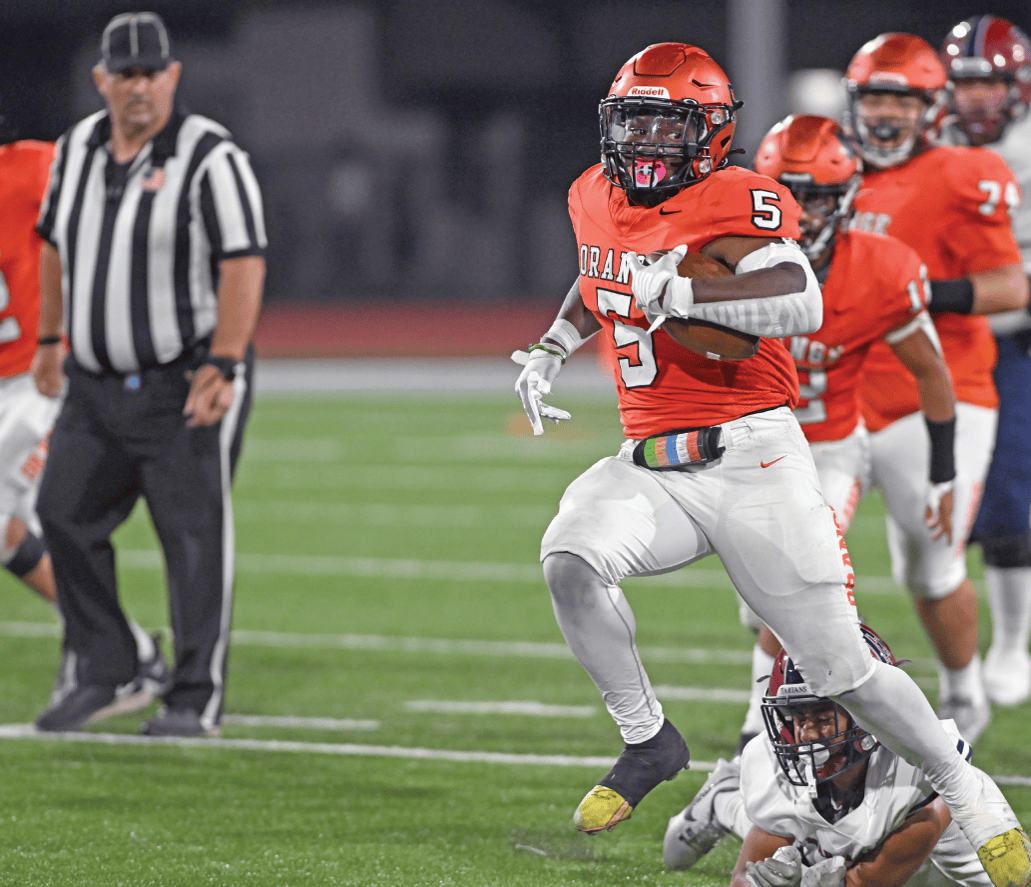
Starting in 2026, NFHS rules allow play cards to be worn on the belt in addition to the wrist or arm. Terry Norris, Anaheim, Calif.
By Joe Jarosz
With two 2026 NFHS rule changes, play cards may now be worn on the belt — in addition to the wrist or arm — and the prohibition of slapping an opponent’s head applies to all players after the words “defense” and “opponent” were removed from the rule. The NFHS Football Rules Committee voted on these changes, in addition to editorial changes and points of emphasis, during its annual meeting Jan. 12-14 in Indianapolis.
“From a rules perspective, I believe the committee feels like the high school football game is in pretty good shape,” said Steve Roberts, chair of the NFHS Football Rules Committee and associate executive director of the Arkansas Activities Association. “The two (rules) proposals that passed do not present significant changes to the game but do clarify and add options to enhance the overall value of the sport to all participants.” The changes were subsequently approved by the NFHS Board of Directors and will be in effect for the upcoming football season, along with previously approved mouthguard rule changes that take effect this year. The changes are presented in perceived order of significance for officials. Consult NFHS publications for official rulings and interpretations.
RULE CHANGES
Illegal Equipment 1-5-3c (9)
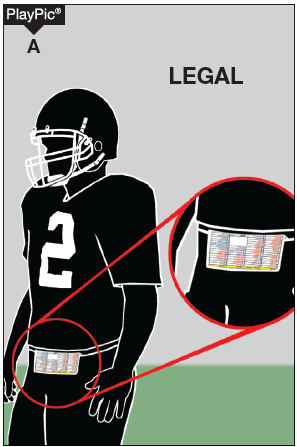
No player shall participate while wearing illegal equipment. Illegal equipment applies to anything that is deemed dangerous, confusing or inappropriate by the officials. Play cards that are not worn on the wrist, arm or belt are considered illegal equipment. That means in 2026, play cards can be worn on the belt (PlayPic A), a practice previously illegal in high school football. The rules committee determined that wearing play cards on the belt poses no safety risk to the player wearing the play card and no danger to his opponent, nor does it present an issue for the image of the game.
Head Slap 9-4-7
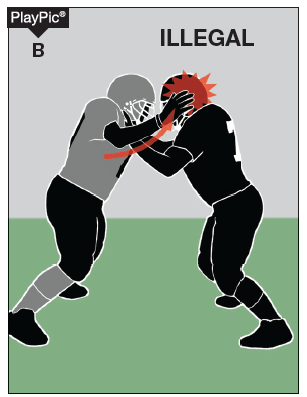
No player may use the hand(s) to slap an opponent’s head (PlayPic B). Previously, the NFHS rule read that no “defensive” player was allowed to slap a “blocker’s” head, potentially creating confusion about an offensive player slapping the head of a defender. Practically speaking, little changes for working officials onfield because the action described would likely have been ruled a personal foul regardless of this definitional change to the rule. In a concerted effort to clarify language, however, the NFHS Football Rules Committee voted to pass the rule change which prohibits the head slapping action equally to the offense and defense. “By eliminating the words ‘defense’ and ‘blocker’s’ from the rule prohibiting slapping an opponent’s head, the prohibition now applies to all players,” said Bob Colgate, NFHS director of sports and sports medicine and liaison to the Football Rules Committee.
Mouthguards 1-5-1d(5)a – 4, 5
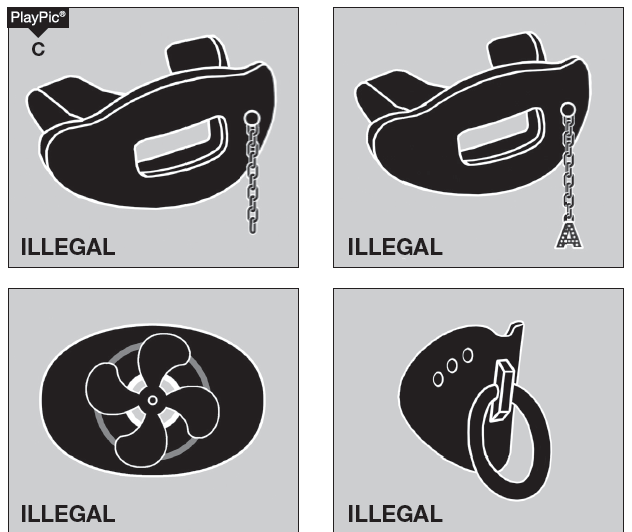
Passed in 2025, but taking effect in 2026, mouthguard attachments that do not serve a purpose and function in protecting the teeth or mouth are illegal. Adornments that present a risk to players are not allowed. For example, pacifier loops, spinning fans and any dangling objects are all examples of illegal attachments (PlayPic C on the next page).
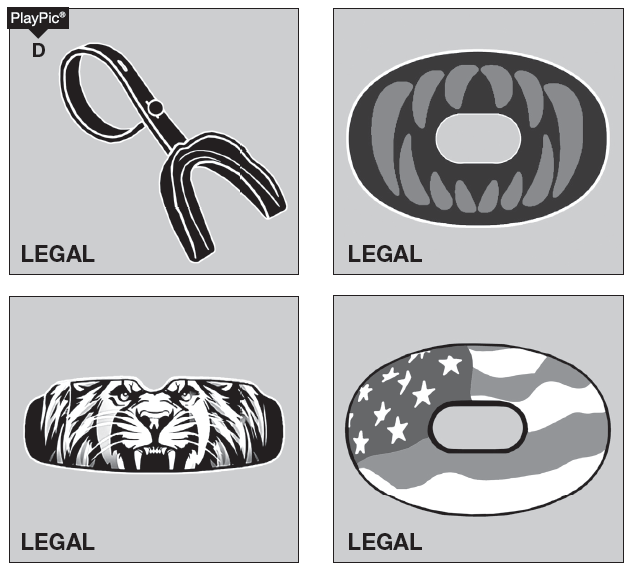
Sublimated designs that are not offensive and do not pose a health or safety risk are not impacted by this rule change. For example mascots, logos and American flags are acceptable design elements for mouthguards (PlayPic D).
Sleeves 1-5-2d, 1-5-3c (6)
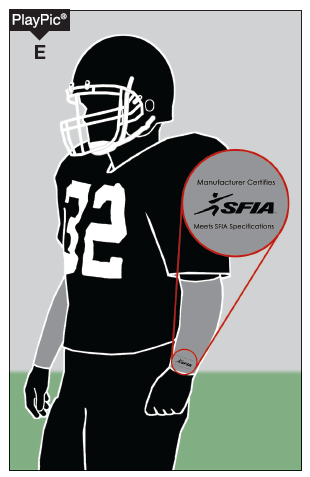
Passed in 2025, but not taking effect until 2027, arm sleeves manufactured to enhance contact with the football or an opponent must meet the specifications determined by the Sports and Fitness Industry Association (SFIA). This includes sleeves attached to a shirt. All sleeves manufactured to enhance contact with the ball or opponent must have a permanent, exact replica of the SFIA seal that must be visible and appear legibly on the exterior of the sleeve (PlayPic E).
EDITORIAL CHANGES
Game Ending Procedure 1-1-8
The game officials’ authority extends through the referee’s declaration of the end of the fourth period or overtime. The jurisdiction of the game officials is terminated and the final score has been approved when all game officials leave the visual confines of the playing area. The game officials retain clerical authority over the game through the completion of any reports, including those imposing disqualifications, that are responsive to actions occurring while the game officials had jurisdiction. State associations may intercede in the event of unusual incidents that occur before, during or after the game officials’ jurisdiction has ended or in the event that a game is terminated prior to the conclusion of regulation play.
Illegal Equipment 1-5-3a (2)
The word “opponent” was removed so competitors are not penalized due to the actions of the opposing team. Illegal equipment applies to slippery or sticky substances of a foreign nature on equipment, towels, uniforms or an exposed part of the body which affect the ball or the opponent, but no longer specifies a substance on the opponent himself in the list of items containing the substance.
Forward Progress After Forward Fumble Out of Bounds 2-15-1
Language regarding a forward fumble out of bounds between the goallines was added to clarify the forward progress definition. Forward progress is defined as the end of advancement toward the opponent’s goal when the ball is in a runner’s possession or when a fumble goes out of bounds and it determines the dead-ball spot. It now includes the clarifying statement that when a forward fumble goes out of bounds or is ruled out of bounds between the goallines it is returned to the spot of the fumble. This change now brings the definition of forward progress in line with the forward fumble rule change approved in 2025.
Disqualified Player 2-32-6
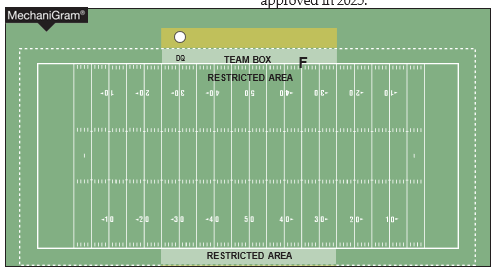
A disqualified player may remain in the team box area and is not required to leave the visual confines of the playing area (MechaniGram F).
Official’s Timeout for Health Risk 3-5-7g
An official’s timeout, which is not charged to either team, occurs during a dead ball and can be issued when circumstances or conditions pose a health risk to participants. Previously, language included “heat or humidity,” which did not specify air quality and other weather conditions that should be considered when evaluating risk to participants.
Snap Election 4-1-3
The phrase “if elected” was removed to avoid confusion. The rule now reads, “A snap shall put the ball in play when a free kick is not specified.”
Line to Gain 5-3-1
Clarifying language was added to specify that when a new series of downs is awarded, the penalties for all fouls committed prior to the ball
being ready for play are administered before the line to gain is established. When the 40-second play clock was adopted, it opened the door for confusion with the ready-for-play being interpreted as the conclusion of the previous play.
Defenseless Player 9-4-3p
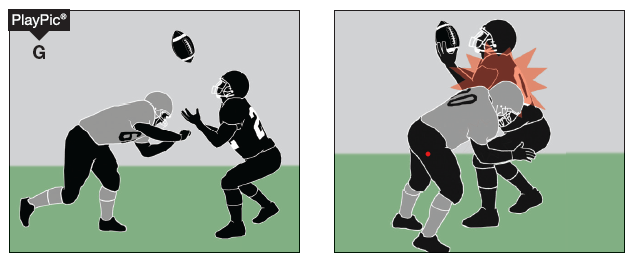
Personal fouls for initiating forceful contact against a defenseless player now include those who are returners of a kick or punt who are attempting to catch the kick or those who have not had time to protect themselves (PlayPic G). Contact by opponents on these returners is only allowed if it’s incidental as a result of making a play on the ball, it is initiated with open hands or is an attempt to tackle by wrapping arm(s) around the opponent.
Basic Spot 9-8 PENALTY
The phrase “basic spot” was added to the penalty statement to clarify that unsportsmanlike and non-player unsportsmanlike penalties are enforced from the basic spot, which is the succeeding spot according to rule 10-4-5.
Spot of the Foul 10-4-4a
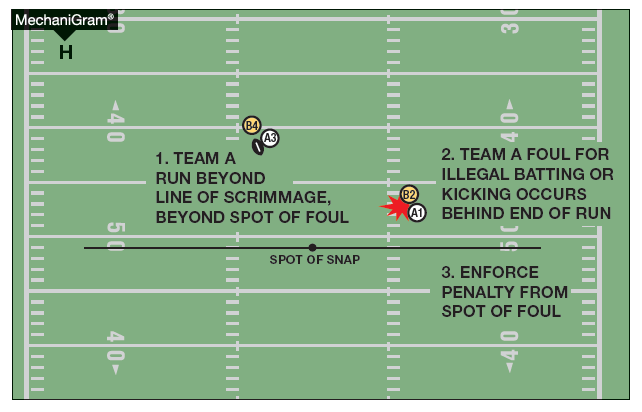
Clarification was given to the difference between “basic spot” and “enforcement spot” so officials are not left deciding which takes precedence The enforcement spot is the spot of the foul for illegal batting or illegal kicking by team A, which occurs behind the basic spot (MechaniGram H).
Previous Spot 10-4-2b
The basic spot is the previous spot unless 10-4-4a, b or d apply for a foul which occurs during a loose ball play, as defined in 10-3-1. This change eliminates redundancy and makes it clear that the basic spot is the previous spot for all fouls, including ineligible downfield, illegal touching by team A and pass interference during a loose ball play.
Offense Fouls in its End Zone 10-5-3
The phrase “and enforcement is from or behind its goalline” was removed to eliminate conflict with recent changes to rule 10-4. If the offensive team commits a foul in its end zone for which the penalty is accepted, the result is a safety.
New Delay of Game Signal
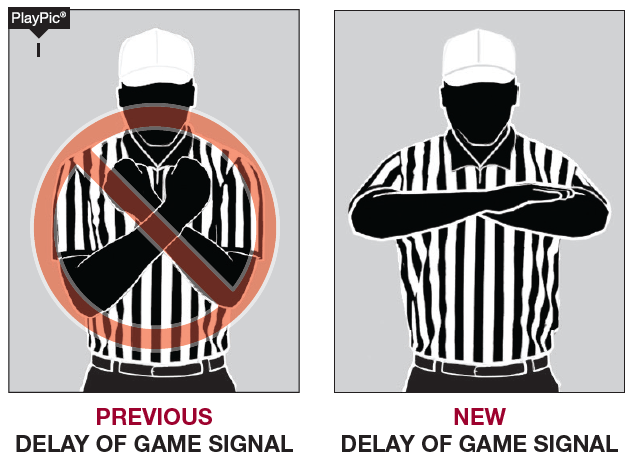
Signal No. 21 has been updated to show the referee’s arms on top of each other parallel to the ground, instead of across the chest (PlayPic I).
POINTS OF EMPHASIS
Flagrant and Unsportsmanlike Fouls
Officials play a critical role in identifying and penalizing flagrant and unsportsmanlike fouls that threaten the safety and integrity
of the game, ensuring the game is played fairly, safely and with respect for all participants.
The NFHS Football Rules Committee reminds that flagrant fouls are the most severe type of personal foul in high school football. The actions constituting these fouls involve intentional, reckless or excessively violent behavior that shows a clear disregard for the safety of others. Flagrant fouls are fouls so severe or extreme that they place an opponent in danger of serious injury. They may also involve violations that are extremely or persistently vulgar or abusive. Examples include fighting, maliciously targeting the head or neck area, striking an opponent or delivering a violent, illegal blindside block or late hit. When a flagrant foul occurs. the penalty is 15 yards and automatic disqualification of the offending player. Removing players who commit flagrant fouls helps prevent serious injuries and stops situations from escalating into further violence.
,Under NFHS rules, unsportsmanlike fouls are non-contact fouls that violate standards of fair play, respect and sportsmanship. Remember, personal fouls involve illegal personal contact and unsportsmanlike fouls do not. When an illegal physical act which falls under the personal foul umbrella is combined with an unsportsmanlike act such as taunting or swearing, officials should penalize as unsportsmanlike conduct so the offending player has a “counter” toward disqualification. Unsportsmanlike fouls include, but are not limited to, taunting, trash talking, threatening gestures, racist comments, choreographed celebrations, and aggressively spiking, spinning or throwing the ball high into the air. Unsportsmanlike fouls can be committed by players, coaches or other team personnel. Each unsportsmanlike foul results in a 15-yard penalty, and anyone who commits two such fouls in one game is disqualified.
Helping the Runner
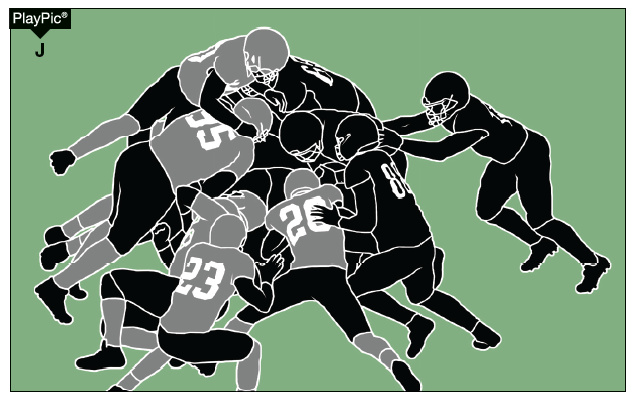
The “tush push” has become a popular football strategy due to collegiate and professional rule codes. Although illegal under NFHS rules, these types of plays are becoming more common in the high school game. The rules committee reminds all stakeholders to work together to curtail this trend of illegally helping the runner in the high school game. The focus on minimizing risk and supporting a balance between offense and defense is in direct conflict with the rise in popularity of strategies to assist the runner. Illegally helping the runner to assist forward progress presents a risk of injury and additional momentum to a particular offensive player swings the balance toward the offense in a manner not intended by the rules. Officials should be aware of forward progress when a runner is clearly stopped. Although a patient whistle is great advice for a vast majority of plays, officials should implement a quick whistle when runners are stood up in a pile and forward progress is clearly stopped. Teammates of the runner who directly contact and push, pull or lift him forward in a clear and obvious attempt to keep the runner’s progress moving forward should be penalized. If such action is simultaneous with or just after the end of the play, and therefore not penalized, officials should utilize preventive officiating measures and remind players about the foul for helping the runner. Of course, not all contact with the runner is illegal. Remember, pushing the pile is legal; direct contact while pushing, pulling or lifting of the runner to assist forward progress is not. As seen in PlayPic J, helping the runner is much more difficult to decipher when he is located in a pile rather than out in the open. Before ruling a foul, officials must be certain the offending player is pushing, pulling or lifting the runner. When in doubt about whether the offending player is contacting the runner or the pile, a foul should not be ruled.
Sideline Management and Control
Sideline management has become a recurring “point of emphasis” because it improves the safety of all participants. It promotes good sportsmanship and professionalism across all levels of play and also prevents unnecessary delays and confrontations that can impact game flow and fairness. The sideline includes the team area and any restricted zones around the field where players and coaches stand during the game. Officials expect this area to be organized and kept clear of unnecessary personnel, and therefore should work to accomplish the goal. Coaches must remain in the designated team area when interacting with game officials, especially for rule discussions. Leaving that area to step onto the field and dispute officiating decisions results in an automatic unsportsmanlike conduct foul.
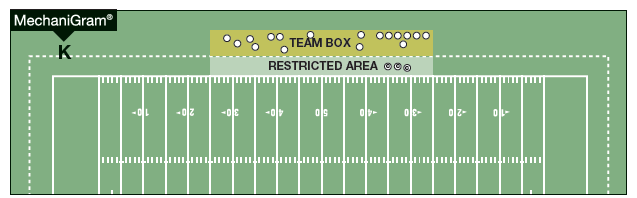
Officials, assigners, observers and supervisors must work together to accomplish a consistent expectation of proper decorum. Coaches are generally only allowed to step toward the sideline (into the working area, often a marked 2-yard border) to call offensive or defensive signals after play has stopped, as seen in MechaniGram K. They must clear this area when the ball is live. The NFHS Football Rules Committee has highlighted the following areas of focus for officials to penalize regarding sideline management and control: Coaches or team personnel entering the field of play to dispute rulings or address game officials outside the coaching area must be penalized; sideline personnel approaching officials with video review devices; prolonged or excessive celebrations or demonstrations that carry onto the field; failure to maintain professional behavior and a standard for sportsmanship.
To minimize the risk of all involved, non-players (including substitutes, athletic trainers and coaches) must remain in their team box and out of any restricted areas, especially while the ball is live. Crowding at the sideline puts players non-players, coaches and officials in danger of severe injury. When non-players are outside of the team box area, or anyone is in the restricted area while the ball is live, game officials will give a sideline warning to the team involved. A second offense results in a 5-yard penalty. All subsequent offenses result in 15-yard penalties for unsportsmanlike conduct fouls, which are charged to the head coach. If an official unintentionally contacts a coach or other non-player in the restricted area while the ball is live, the team is assessed a 15-yard penalty for a non-player, illegal personal contact foul. As a non-player foul, the penalty is enforced from the succeeding spot. A second such offense would result in the head coach’s disqualification. Unlike a foul for sideline interference (non-contact, Rule 9-8-1k or 9-8-3), no warning or 5-yard penalty is required in this situation.
Officials are reminded that sideline warnings are used only for non-contact interference. When physical contact is made, or when any issue regarding unsportsmanlike behavior arises, yardage penalties must be enforced in order to maintain proper decorum and consistency from game to game across the country.
Identification of the NFHS Authenticating Mark on Game Balls
The NFHS Authenticating Mark ensures easy identification of inflated and non-inflated balls used in interscholastic competition for which the NFHS writes playing rules. All such balls are required to display the NFHS Authenticating Mark. The use of conforming equipment is essential to the integrity of contests played under the NFHS rules. This mark helps to promote a level playing field by ensuring consistency in the equipment being used. The mark allows for the development of more sophisticated standards in balls and clearly communicates to administrators, coaches and game officials that these standards are being met. Non-compliance with these requirements will be reported to the state association following the contest for potential penalties. Administrators and coaches play a pivotal role in making sure all inflated and non-inflated balls meet these specifications. They must instill the importance of proper equipment use through consistent reinforcement during the pre-competition certification meeting and throughout the season. Officials must also remain vigilant and report any non-compliant balls to the state association office.
Joe Jarosz is an associate editor for Referee. He officiates college football and high school basketball. *
